

About the fonds
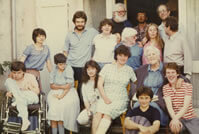
The L’Arche Trosly-Breuil fonds is an audiovisual collection consisting of recordings of lectures and retreats given by Henri Nouwen while living at L’Arche Trosly-Breuil, France. The fonds also includes a number of photographs of L’Arche Trosly-Breuil and individuals associated with L’Arche.
L’Arche Trosly-Breuil was the first of the L’Arche International communities, located in Trosly-Breuil, France and created by Jean Vanier in 1964. L’Arche Trosly-Breuil began when Vanier became increasingly aware of the difficulties that individuals with developmental disabilities face through his connections with Father Thomas Philippe. Vanier began his work when he took two men, Raphael Simi and Philippe Seux, out of an institution and invited them to live with him in his home in Trosly-Breuil and named their home L’Arche, or “The Ark”.
At L’Arche Trosly-Breuil, individuals with intellectual disabilities, called core members, live with assistants in group homes. As a community, L’Arche Trosly-Breuil supports personal growth and creativity, all while developing strong friendships and support groups between community members. L’Arche Trosly-Breuil was the first of the L’Arche communities, which have now expanded within fourty countries worldwide.
Henri Nouwen was a close friend of Jean Vanier and was invited to join the L’Arche Trosly-Breuil and was an active member of their community from August 1985 to May 1986. His experiences at Trosly-Breuil are published in his work The Road to Daybreak: A Spiritual Journey (Doubleday, 1988).
The fonds consists of audio recordings of lectures and retreats given by Nouwen while at Trosly-Breuil between 1985 and 1986 as well as one compact disc of photographs ranging in date from 1985-2008. The compact disc material was transferred to the Kelly Library Archival and Manuscripts Collections by Sue Mosteller in March 2009. The audio cassette material was gathered by Simone Landrien at L’Arche Trosly-Breuil. These materials were then given to Sue Mosteller, who transferred this material on February 9, 2010.
Finding Guide
The exent of the fonds is eleven audio cassettes and one compact disc. The date range is 1985-2008.
No Finding Guide is available at this time. Series and item level descriptions are available in the Archives through the in-house archival database.
Related Material
L’Arche International/Internationale
Audiovisual Collection